
Last updated November 2, 2026
 Wrought iron
 Wood & steel frame
 Farm & ranch
 Sliding driveway gates
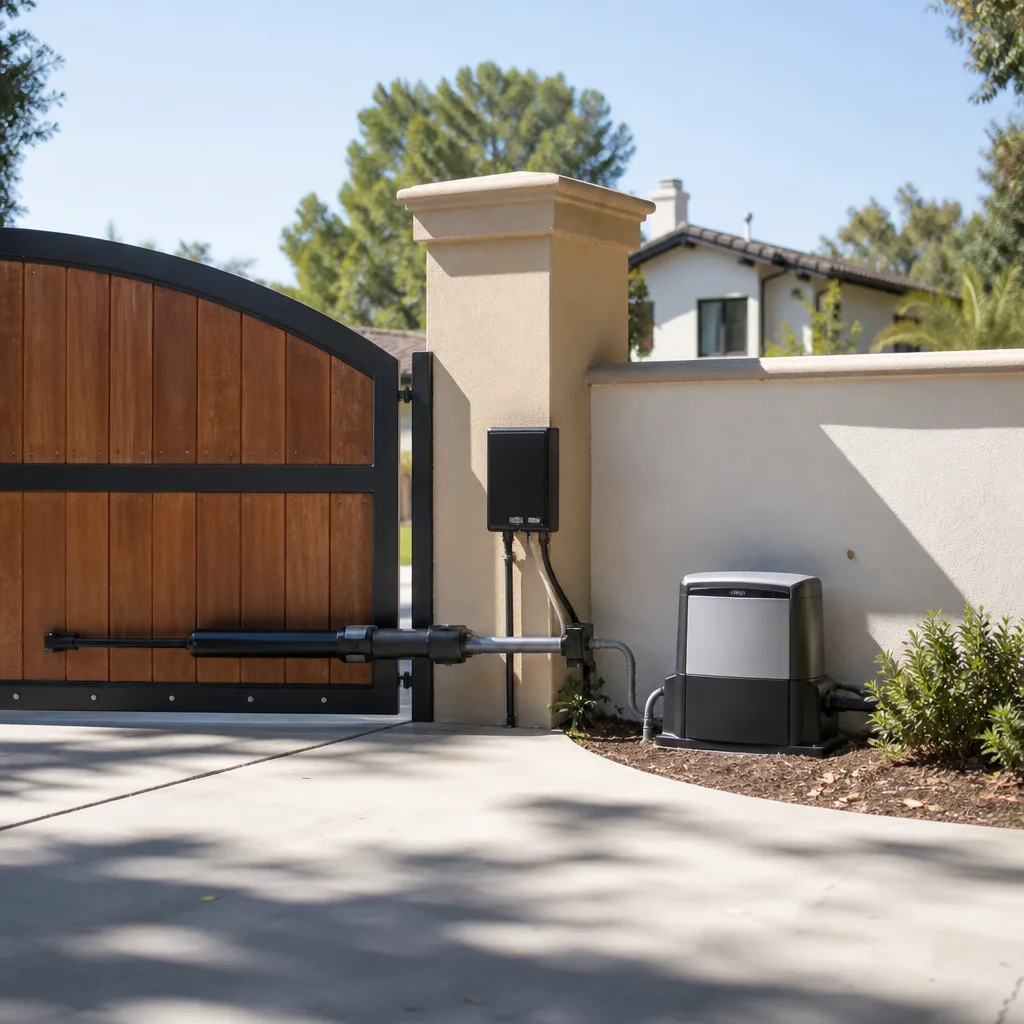 LiftMaster operators
Free on-site gate assessment - hinges, posts, and your LiftMaster or Nice gate operator checked before anything is quoted
The assessment is free and the quote is the invoice.
Get your free estimateDIY vs Professional Gate Repair: The Almaden Homeowner’s Decision Guide
Replacing a remote battery is DIY. Adjusting a gate operator’s limit switches without understanding the entrapment protection consequences is how people get hurt, and how homeowners unknowingly void their operator warranty. Walk the aisles of any Almaden hardware store and you’ll find hinges, gate wheels, and latch parts hanging next to light bulbs, as if a driveway gate were just another weekend project. It isn’t. Some gate repairs are genuinely simple, safe, and worth doing yourself. Others involve UL 325 entrapment requirements, high-tension components, and control board programming that can turn a $200 repair into a $1,800 replacement. This guide separates the two, component by component, so you can make the call with confidence: which repairs to handle yourself, which to hand to our Gate Repair services, and what to do if you’ve already started a DIY repair you regret.
Styles & brands we work with
- Wrought iron
- Wood & steel frame
- Farm & ranch
- Sliding driveway gates
- LiftMaster operators
Quick Answer
DIY gate repair is safe and sensible for mechanical wear items like hinges, wheels, latch adjustments, and remote batteries, but most electric gate problems, especially anything involving operators, control boards, photo eyes, or entrapment sensors, should be handled by a trained professional in Almaden. The deciding factor isn’t your confidence level. It’s which component failed, the tools required to diagnose it correctly, and the code compliance implications of getting it wrong. Our general rule: if the repair involves line voltage, a control board, or anything governed by UL 325 entrapment standards, call a gate specialist at (833) 620-6313 before you touch another wire.
Table of Contents
- Component-by-Component: What’s DIY vs Professional?
- Repairs Homeowners Can Safely Handle
- Repairs That Require a Gate Technician
- UL 325 Entrapment: The Code That Changes Everything
- Tools and Skills Actually Needed for DIY Gate Work
- Control Boards and Access Systems: Why DIY Goes Wrong
- Already Started a DIY Repair and Realized You’re in Over Your Head?
- Common Mistakes to Avoid
- When to Call a Professional
- Frequently Asked Questions
- The Bottom Line
Component-by-Component: What’s DIY vs Professional?
Every gate failure traces back to a specific component. Once you identify which one, the DIY-vs-professional decision mostly makes itself. Here’s the breakdown we use when Almaden homeowners call us asking whether they can fix something themselves. If the component is on the left, save the service call. If it’s on the right, call a specialist before the problem compounds.
| Component | DIY or Professional? | Reason |
|---|---|---|
| Remote control battery | DIY | No tools, no risk, no programming. Slide the cover, swap the battery. |
| Hinge lubrication or replacement | DIY | Mechanical work, low risk, standard wrenches. Requires lifting the gate off its posts safely. |
| Gate wheel or roller replacement | DIY | Bolt-on part, low skill threshold. Wrong-size wheel can damage the track, so measure first. |
| Latch adjustment or replacement | DIY | Standard hardware, hand tools. Geometry matters: a misaligned latch gets worse, not better. |
| Track cleaning and debris removal | DIY | Preventive maintenance, no tools beyond a brush and maybe a vacuum. |
| Photo eye alignment (minor) | DIY, carefully | If one eye is clearly bumped out of alignment, a visual realignment can work. If alignment doesn’t fix it, stop. |
| Operator limit switch adjustment | Professional | Incorrect limits can override entrapment protection. UL 325 compliance risk. This is a hard no for DIY. |
| Control board replacement or repair | Professional | Requires multi-meter diagnosis, brand-specific programming, and reverting corrupt settings. |
| Keypad or intercom system repair | Professional | Access control systems store codes in memory. A wrong reset sequence erases everything. |
| Spring or counterweight replacement | Professional | High tension. A failing spring can release enough force to cause serious injury. |
| Gate post resetting or concrete work | Professional, sometimes licensed contractor | Structural work. Foundation depth and post alignment affect gate operation and safety. |
The pattern is clear: mechanical wear parts are homeowner territory. Electrical and structural systems aren’t. In Almaden, where many homes sit on sloping lots and driveways carry heavy, custom gates, that line matters more than in flat, newer subdivisions. A gate that’s slightly out of balance on a steep grade puts more strain on every hinge, wheel, and operator cycle.
Repairs Homeowners Can Safely Handle
Some gate repairs are legitimately accessible. You don’t need a trade background, and you won’t void a warranty or violate a code by doing them. Here’s what we tell Almaden homeowners it’s fine to take on.
Remote control battery replacement
This one takes thirty seconds and costs about three dollars. Most remotes use a CR2032 coin cell or a 12-volt A23 battery. Slide the back cover off with your thumbnail, note the orientation of the old battery, swap in the new one, and test. If the gate still doesn’t respond, the problem isn’t the battery. At that point, don’t start opening the operator. Call us at (833) 620-6313 and we’ll diagnose whether the issue is the remote, the receiver, or the operator itself.
Hinge lubrication
Gate hinges wear out for one predictable reason: friction. A dry hinge puts unnecessary load on the entire gate system, eventually bending the hinge pin or pulling screws loose from the post. Lubricating is simple. Use a penetrating lubricant like PB Blaster or a silicone spray for the pivot points. Wipe away excess. Do this twice a year, and you’ll extend the life of hinges that would otherwise need replacing in three to five years instead of eight to ten.
Gate wheel or roller replacement
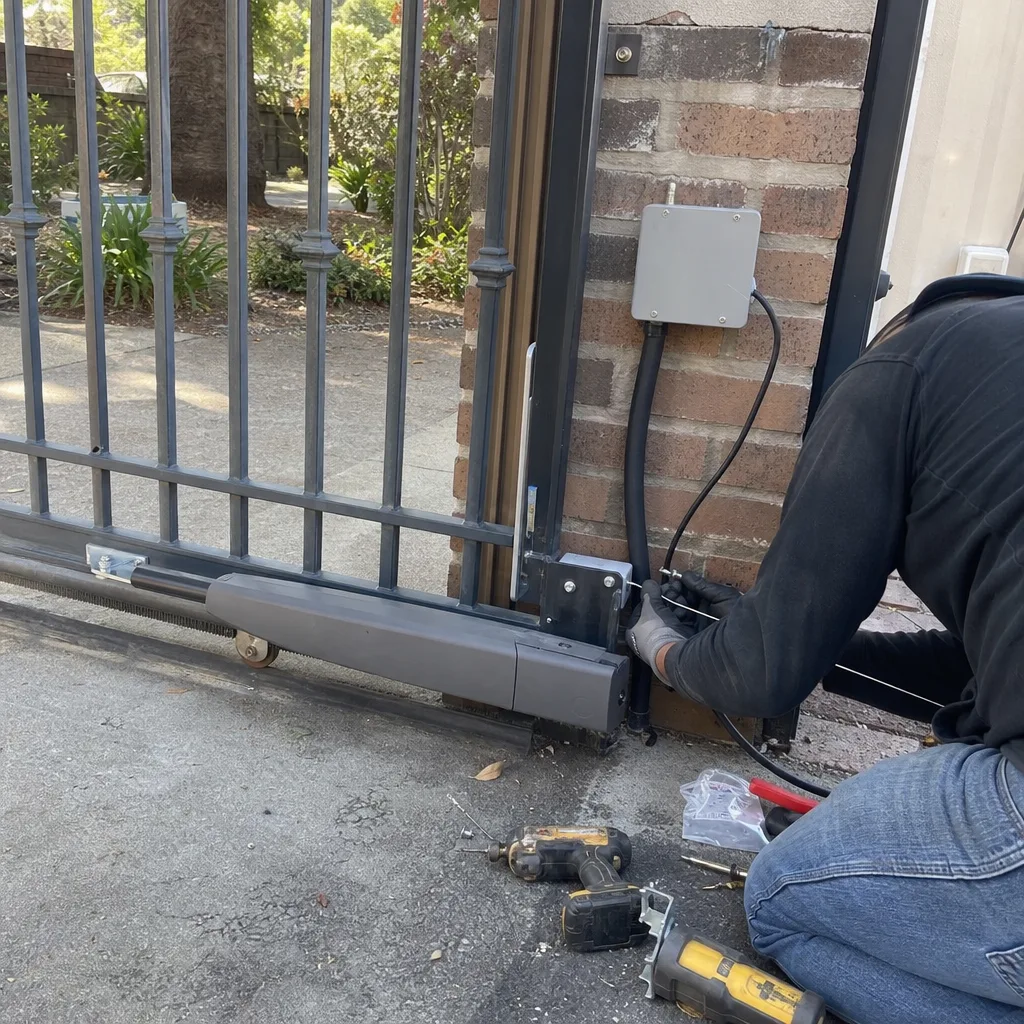
Sliding gates ride on wheels that flatten over time, especially on heavy steel gates that cycle dozens of times a day. If your gate is grinding or jerking, run your hand along the track. A flat spot on a wheel is obvious. Replacing the wheel is a bolt-on job: raise the gate slightly, unbolt the old wheel assembly, install the new one, lower the gate. Critical step: match the wheel diameter and material exactly. A wheel that’s too small drops the gate lower and can bind the track. Too large, and the gate scrapes or catches.
Latch adjustment
A latch that no longer catches is usually a matter of alignment, not breakage. Gate settles, posts shift slightly, the strike plate ends up a quarter-inch from where it should be. Loosen the latch mounting screws, reposition to engage the post, tighten. Five minutes with a Phillips head and a level. If the latch itself is broken or the post has moved more than a half-inch, that’s a different conversation. Post movement indicates a foundation issue, and no amount of latch adjustment fixes a sinking post.
Repairs That Require a Gate Technician
Everything in this category falls onto the professional side of the line for a reason, not out of caution. These repairs involve one or more of three factors: line voltage, stored tension, or UL 325 code compliance. Any one of those factors makes DIY the wrong call. Here’s the breakdown.
Operator limit switch adjustment
Limit switches control where the gate stops at open and closed positions. Adjusting them sounds simple: turn a screw, set the travel, done. But on powered gate operators, limit switches are intertwined with the entrapment protection system. If you set the close limit too tight to make the gate seal flush, you can defeat the inherent entrapment sensing on a LiftMaster or BFT operator, meaning the gate no longer reverses when it contacts an obstruction. That’s how people get pinned, and how a code-compliant gate becomes a liability. A gate technician with brand-specific training on your operator knows how to set limits while preserving the UL 325 reverse-on-contact function. Homeowners guessing at it don’t.
Control board replacement
Control boards are the brain of an automatic gate. They hold the programming for open and close delays, auto-close timing, safety edge sensitivity, and access code storage. Replacing one isn’t like swapping a light switch. It requires diagnosing that the board is actually the failed component, not the transformer feeding it or a short in the wiring downstream. Then the replacement board needs to be matched to the operator brand and model, and configured. We work on boards for electric gate repair in Almaden across LiftMaster, FAAC, BFT, Linear, and others, and one pattern we see constantly: a homeowner replaces a board on a hunch, the board self-protect trips because the underlying short wasn’t fixed, and now there’s a new $400 board that’s dead, too.
Spring and counterweight replacement
Heavy cantilever and swing gates use springs or counterweights to balance the gate’s weight so the operator doesn’t have to muscle hundreds or thousands of pounds through every cycle. When a spring fails, it fails catastrophically. A gate spring under load can release enough energy to break a wrist or worse. Replacing one requires knowing the exact spring specification, safely unloading tension, and re-rigging the gate. There is no safe DIY version of this repair. If your gate suddenly slams or drops, lock it open if possible and call us.
Keypad and intercom repair
Access systems look simple: a keypad with numbers, a couple of wires. But the programming layer is deeper than the hardware. Modern systems store dozens or hundreds of access codes, integrate with intercoms and mobile credentials, and sync with the operator’s control board. A wrong key sequence during a “simple” keypad replacement can erase the entire code database. One Almaden HOA we worked with had a resident try to troubleshoot their Viking keypad. The result: 140 stored codes wiped, a full reprogramming required, and a week of manual gate staffing because the gate wouldn’t open automatically. The keypad fix was quoted at $180. The damage repair was $1,400.
UL 325 Entrapment: The Code That Changes Everything
UL 325 is the national safety standard for automatic gates. It exists because gates kill people when entrapment protection fails. The standard mandates that every automatic gate system installed or worked on in the United States include specific safety devices: photo eyes that detect an obstruction, reverse-on-contact edges that stop and reverse the gate when they touch something, and audible or visual warning systems in certain configurations. Almaden falls under the same UL 325 requirements as every other municipality in California.
Here’s the part most homeowners don’t realize: working on a gate operator is not the same as working on a doorbell. When a gate technician adjusts an operator, replaces a control board, or reroutes safety wiring, they’re certifying indirectly that the system still meets UL 325 requirements after the repair. If a homeowner does that same work and the gate later injures someone, the homeowner assumes liability for a system that no longer complies with a national safety standard. Home insurance policies have denied claims in exactly these situations.
In our experience, the two most common UL 325 violations we see in Almaden are defeated photo eyes and missing or bypassed safety edges. A photo eye that keeps faulting gets unplugged. A safety edge that gets crushed gets removed and never replaced. The gate “works” but it no longer reverses on contact. If you suspect your gate is missing or bypassing a safety device, that’s an immediate call to (833) 620-6313, not a “maybe next weekend” item.
Learn more about what a full-system electric repair involves at our Almaden electric gate repair page.
Tools and Skills Actually Needed for DIY Gate Work
Forget the generic “you’ll need a screwdriver and a wrench” lists. Here’s what the legitimate DIY gate repairs actually require, based on the specific components you’ll work on.
For hinge and latch work
- A set of combination wrenches from 3/8″ to 3/4″ (or a full metric set, 10mm to 19mm)
- A 3/8″ drive socket set with extensions for hard-to-reach bolts
- A level to verify gate alignment before and after
- A helper or a gate jack. A full-size driveway gate is heavy. Trying to support it with one arm while wrenching with the other is how fingers get crushed
- Penetrating lubricant for seized hardware
For wheel and track work
- A floor jack or bottle jack rated for the gate’s weight
- Wood blocks for support shims, never concrete blocks (they crumble)
- A dial caliper or precision tape to measure existing wheel diameter and axle size
- Replacement wheels matched to the exact diameter and material
Skills required
None of this is advanced. You need the ability to read a level, recognize when a bolt is cross-threading, and know when to stop before making something worse. The most underrated skill in DIY gate work is recognizing the line between “adjust” and “replace.” A hinge that needs a quarter-turn on a screw is DIY. A hinge where the pin wobbles in the body is replacement, and on a heavy gate, replacement means lifting the gate safely. If you don’t have a gate jack and a helper, you’re not equipped for that job, and that’s fine. That’s what we’re here for.
One more note specific to Almaden: many driveway gates here are on sloped driveways. Working on an incline introduces an additional risk, because the gate wants to roll downhill. Block the wheels securely before loosening anything. A gate that rolls away on a slope has enough momentum to cause real damage to a car, a fence, or a person.
Control Boards and Access Systems: Why DIY Goes Wrong
Control boards fail for three main reasons: power surges, water intrusion, and component age. None of those are fixable by wiggling wires. Yet we get calls from Almaden homeowners who’ve opened the operator cover, stared at the board, and started pressing buttons or shorting terminals based on a forum post. Here’s what actually happens.
Control boards are not plug-and-play. A LiftMaster board doesn’t swap into a FAAC operator. Even within the same brand, a board revision from three years ago may not talk to the current motor harness. When a board is replaced, the technician must match not just the brand, but the model, revision, and firmware version. Then the board needs the original operating parameters restored: open/close limits, auto-close delay, safety device inputs, and access code integration.
When a homeowner jumps a terminal or resets a board hoping to clear a fault code, one common outcome is programming corruption. The board forgets its parameters and defaults to a locked state. Some operators then require a master reset procedure that isn’t in the manual and isn’t available on the manufacturer’s website. Now you’re paying for a service call to undo what the forum post told you to do, on top of the original repair. We’ve restored enough corrupted boards to say this plainly: the “quick reset” is the most expensive mistake in DIY gate repair.
Access systems carry the same risk. Keypads, intercoms, and card readers tie into the operator through the control board. When a keypad is replaced, it needs to be configured for the operator’s input protocol. When an intercom is added or repaired, its relay output needs to be matched to the board’s accessory input. Get these wrong, and you’ll have a keypad that beeps but doesn’t open the gate, or an intercom that rings but can’t trigger the operator. Both are signs of a communication mismatch, not a dead part. Diagnosing that mismatch requires brand-level familiarity, which is exactly what a gate specialist brings to the job.
Our Almaden gate repair team handles the full electric stack, from board diagnostics to keypad reprogramming, because we work on these brands daily, not occasionally.
Already Started a DIY Repair and Realized You’re in Over Your Head?
It happens more often than homeowners admit. Maybe the gate is disassembled in the driveway. Maybe the operator cover is off and there are wires hanging. Maybe you’ve replaced a part you bought online and the gate still doesn’t work. Here’s exactly what to do.
- Stop disassembling. Do not remove any additional parts. The current state of the gate is now your repair baseline. Every part you remove after this point makes reassembly harder and the eventual service call longer.
- Photograph everything. Take clear photos of the wiring, the component locations, and the parts you’ve removed. A good technician can often reconstruct the original configuration from photos. Without them, we’re working from memory and the manufacturer’s schematic.
- Secure the gate. If the gate is unlatched or partially disassembled, lock or block it in a safe position. An unsecured gate on an Almaden hillside is a hazard to your family and your neighbors. This is not about pride, it’s about safety.
- Do not reconnect power. If you’ve been working on anything electrical and you’re not sure about the wiring, leave the breaker off. Powering up a mis-wired operator can fry the board, the transformer, or the motor in under one second.
- Call us and tell us the truth. Call (833) 620-6313 and describe exactly what you did: which parts you removed, which wires you disconnected, which settings you changed. We’ve seen every version of this, and knowing the full story from the start means the repair gets quoted accurately instead of discovered halfway through. We’re not here to judge, we’re here to fix it.
The good news: most half-finished DIY gate projects are completely recoverable. The more honest you are about what you changed, the faster we can restore the system to working condition. And if you’ve removed a part that’s still serviceable, we’ll tell you and reinstall it. We won’t replace parts that don’t need replacing.
Common Mistakes to Avoid
- Adjusting operator limits to fix a noisy gate. A noisy gate usually indicates a mechanical problem: a worn wheel, a dry hinge, a misaligned track. Tightening the close limit to make the gate “seat” harder masks the symptom and defeats the UL 325 entrapment threshold. Fix the mechanical issue instead.
- Bypassing a photo eye that keeps faulting. A photo eye that faults repeatedly is telling you something: misalignment, a bad wire, or a failing sensor. Unplugging it or jumping the terminals restores automatic operation but removes the primary entrapment protection. In Almaden, where many gates open directly onto sidewalks, this is a serious liability.
- Buying a “universal” replacement part. There is no universal control board. There is no universal safety edge. Even universal remote controls only work with receivers designed to accept them. Purchasing the cheapest visibly similar part online usually results in an incompatible component and a return shipping label.
- Ignoring gate weight when replacing wheels. A wheel rated for 400 pounds won’t survive long under a 900-pound wrought iron gate. It’ll flatten within months. Match the wheel to the gate’s actual weight, not its size.
- Using WD-40 on everything. WD-40 is a water displacer, not a long-term lubricant. It works for freeing seized hardware, but it evaporates quickly and leaves little protection. Use a proper silicone or lithium grease for hinge pivots and wheel bearings.
- Trying to straighten a bent gate post with a sledgehammer. Bent posts indicate a vehicle impact or ground movement. Hammering the post “back into place” weakens the steel and destroys the alignment geometry. A bent post needs professional replacement or structural repair, often with new concrete.
- Leaving a half-finished repair overnight. An open gate, an exposed operator, or a dangling wire is an invitation for weather, animals, and curious children. If you can’t finish the job in one session, secure the gate and cover the opening. Better: call us before starting.
When to Call a Professional
You should call a gate specialist when the problem involves any of these: the operator motor, the control board, the limit switches, the safety edges, the photo eyes, the keypad or intercom, or any spring under tension. That list covers the majority of gate failures because the majority of gate failures are electric or structural, not cosmetic.
In Almaden, we also see a cluster of calls related to hillside gates: operators overheating from running extended cycles on a steep grade, gates pulling loose from posts set in saturated clay soil, and track systems that bind as the ground shifts slightly each winter. These are all specialist-level problems. Gate Repair Almaden offers free estimates in Almaden for gate repairs, electric gate diagnosis, and full gate installation in Almaden. Call (833) 620-6313 with a description of the problem, and we’ll give you a straight answer on whether it’s a repair worth scheduling or something you can handle with a wrench and fifteen minutes.
Frequently Asked Questions
Gate repair in Almaden typically ranges from $150 to $600 for mechanical fixes like hinge replacements, wheel changes, and latch adjustments, while electric gate repair involving control boards, operators, or access systems ranges from $250 to $1,800 depending on the failed component and system complexity. The price is always quoted and agreed before any work starts. For an exact estimate on your specific gate, call (833) 620-6313, estimates are free.
For repair work, yes, we aim for same-day or next-day service in Almaden when an emergency gate failure locks you in or out. Electric gate failures that leave a security gap are prioritized. Installations and full system replacements are scheduled in advance, not same-day. Call us and we’ll tell you the soonest available window for your situation.
We’re trained on and equipped to service the major gate operator brands: LiftMaster, FAAC, BFT, Linear, Viking, Ghost Controls, DoorKing, Elite, and Mighty Mule. That means we diagnose and source parts for the exact system already on your property, rather than pushing a generic replacement. If your gate runs on one of these brands, we work on it.
No. In most cases, a failed operator doesn’t require replacing the gate itself. Operators fail independently of the gate leaf, and swapping the operator while keeping the existing gate structure is a standard repair. We’ll tell you honestly if the gate itself is aging to the point where replacement makes more financial sense than repeated repairs, but a dead operator alone is not a reason to replace the entire system.
A full gate installation includes site assessment, gate and post selection sized to your driveway and terrain, excavation and foundation work, gate hanging and alignment, operator installation and programming if automated, safety device installation to meet UL 325 standards, and final testing. We handle both the gate structure and the electric automation, so you’re not coordinating between a welder and an electrician. For a free measure and written quote on a new gate in Almaden, call (833) 620-6313.
Yes. The full electric stack, operator, control board, keypad, intercom, safety edges, photo eyes, and power supply, is part of our core electric gate repair service. We run power to the operator location and install or replace safety devices to bring the system into UL 325 compliance. For questions about your existing electric gate or a new automated installation, call (833) 620-6313 and ask for a free evaluation.
The Bottom Line
The DIY-vs-professional decision for gate repair in Almaden comes down to one thing: what failed. Mechanical wear items like hinges, wheels, latches, and remote batteries are safe, affordable, and realistic for a homeowner to handle with basic tools and a careful eye; see more guides & resources for details. Everything else, operators, control boards, springs, safety devices, access systems, carries enough electrical, structural, or code-compliance risk that professional repair is the only sensible choice.
If you’re unsure, call (833) 620-6313 before you start disassembling. A five-minute conversation costs nothing and can save you from a repair that spirals from simple to structural. Gate Repair Almaden is a gate specialist, not a generalist, and we’d rather answer your question on the phone than rescue a half-finished DIY job at 8 p.m.
Written by the team at Gate Repair Almaden, serving Almaden since 2018.
See the difference
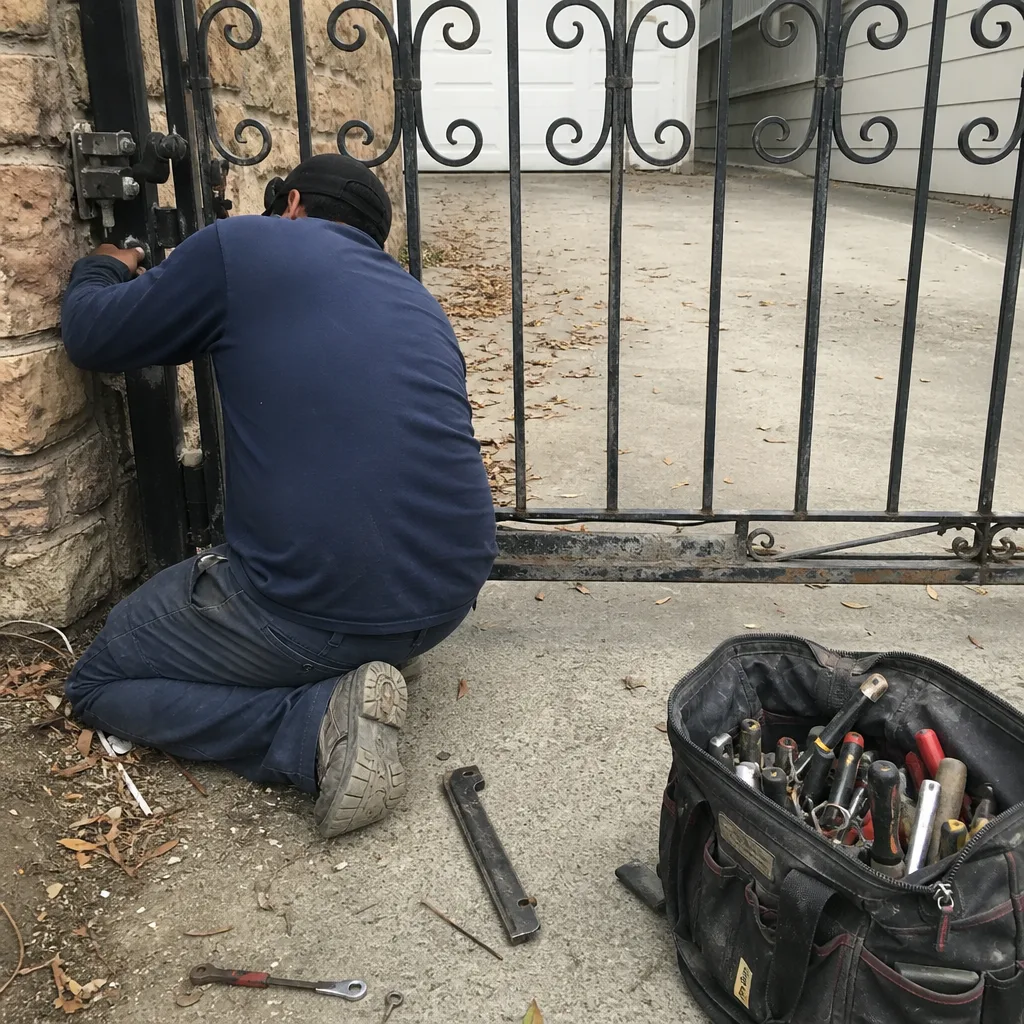 Before
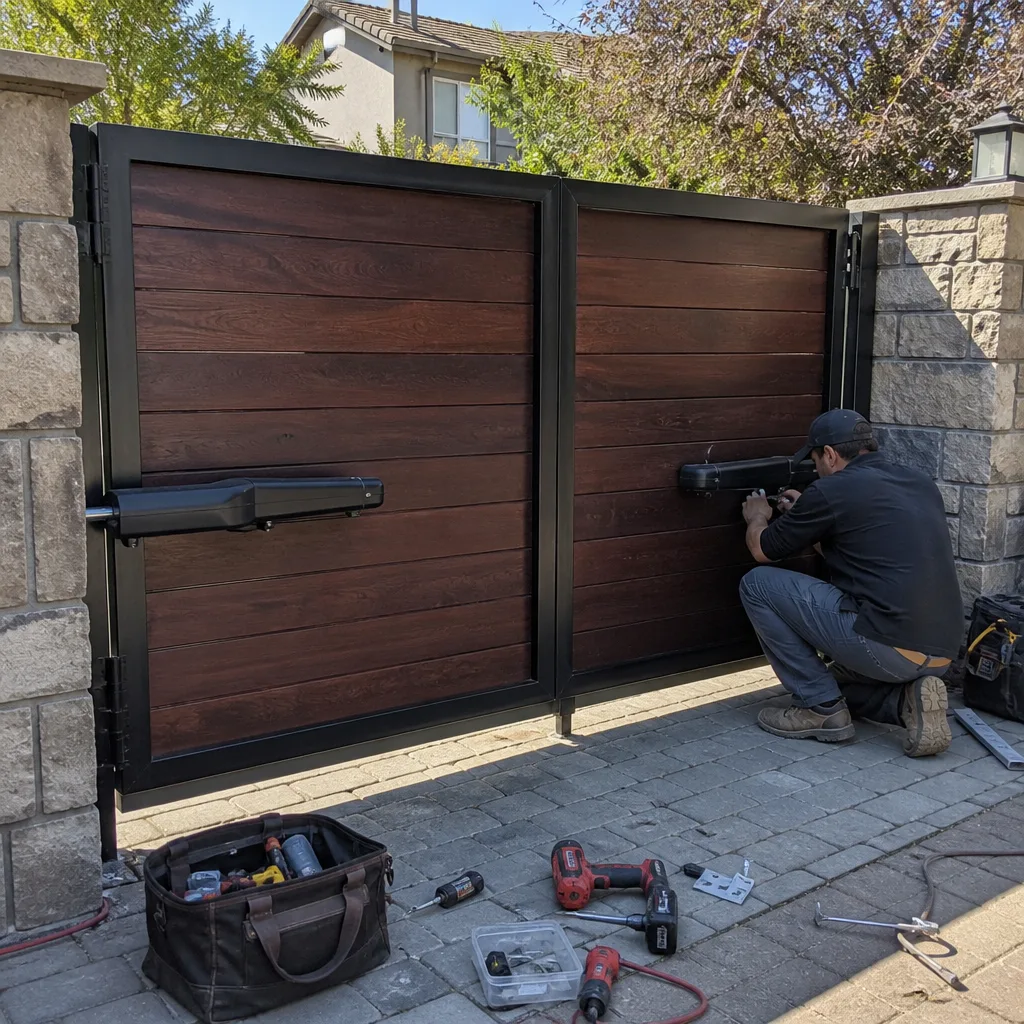 After
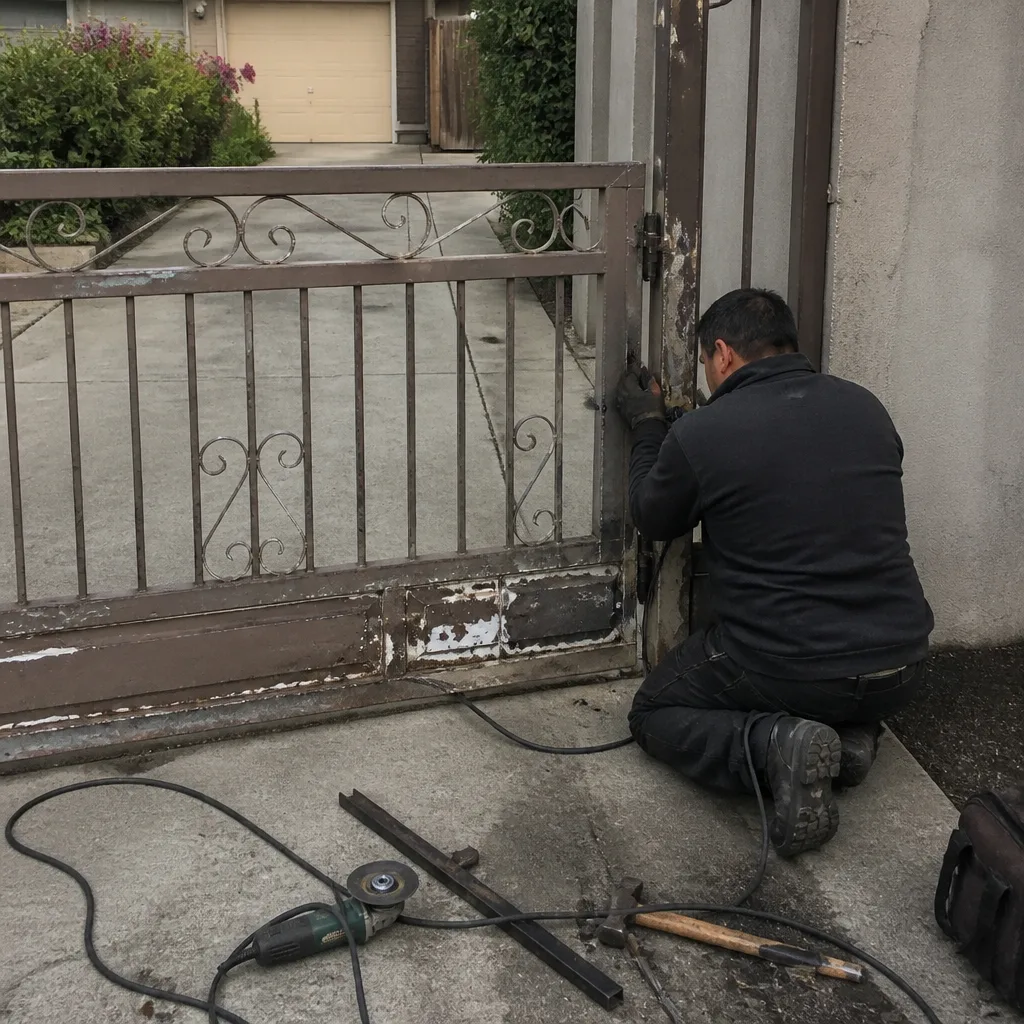 Before
 After
 Before
 After